How Long Can a Dryer Vent Duct Be?
The short answer is 35 feet — but that's the equivalent length, not the physical measurement of your duct. Every elbow in the run subtracts from that number. Here's how to calculate your actual limit and what to do when you're over.
🧮 Quick Equivalent Length Check
Enter your configuration below. For the full calculator with detailed breakdown, see the Duct Length Calculator.
Understanding Equivalent Length vs. Physical Length
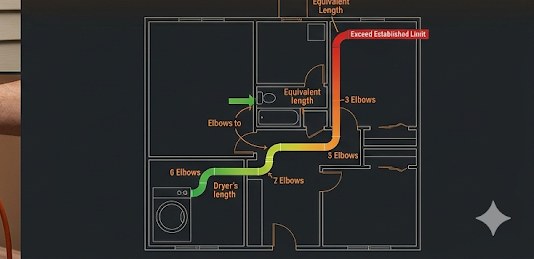
Physical length is how far the tape measure runs from the back of the dryer to the exterior termination cap. Equivalent length is a calculated value that accounts for the additional airflow resistance created by elbows — because a 90° turn in ductwork creates the same resistance as approximately 5 feet of straight duct.
This is not a code technicality — it reflects real physics. A duct with two 90° elbows has 10 feet of additional equivalent resistance even if the physical run is only 15 feet. Total equivalent length: 25 feet. That run passes. Change it to three 90° elbows and you're at 30 equivalent feet — still passing, but close. Four 90° elbows (20 equivalent feet of elbows) plus 15 physical feet = 35 equivalent feet, right at the limit.
The Elbow Deduction Table
| Fitting Type | Equivalent Length Deduction | Example |
|---|---|---|
| 90° elbow (standard radius) | 5 feet per elbow | 2 elbows = 10 ft deducted from 35 ft allowance |
| 45° elbow | 2.5 feet per elbow | 4 elbows = 10 ft deducted |
| Flex transition duct | Counts as physical length (1:1) | 6 ft flex = 6 ft toward the 35 ft limit |
| Periscope/offset fitting | Typically 0–2 ft depending on manufacturer listing | Check the specific fitting's listed equivalent length |
| Exterior termination cap | Does not count toward equivalent length | Cap resistance is accounted for differently |
Why 35 Feet? Where This Number Comes From
The 35-foot limit is based on the exhaust velocity needed to carry moist, lint-laden air from the dryer drum to the exterior without allowing significant lint deposition along the way. Modern residential dryers are designed to produce enough static pressure to push air through approximately 35 equivalent feet of 4-inch duct against the resistance of a standard gravity-damper cap.
Beyond 35 equivalent feet, exhaust velocity drops enough that lint begins to drop out of the airstream and accumulate on duct walls. This is the mechanism behind most dryer duct fires — not the temperature of the exhaust air itself, but the accumulated lint that the air stream can no longer carry.
Some manufacturers specify a shorter maximum duct length in their installation manuals. When the manufacturer's specification is more restrictive than the IRC, the manufacturer's specification governs. Always check your dryer's installation manual, not just the code.
What Changes for Gas Dryers
Gas dryers require all the same duct provisions as electric dryers, with one additional concern: backdrafting. Because a gas dryer has an open combustion chamber, significant negative pressure in the exhaust duct — caused by a long run with poor airflow, a blocked cap, or an incorrectly installed booster fan — can pull combustion gases backward. For gas dryers, staying well within the equivalent length limit is especially important, and roof termination (which creates the longest runs) is particularly discouraged.
Flex Duct: The 8-Foot Rule and Why It Matters
Flexible transition duct — the semi-rigid aluminum accordion type — is only permitted as a transition from the dryer to the wall connection. The IRC does not specify an explicit 8-foot limit in all versions, but many jurisdictions adopt this limit and most dryer manufacturers specify it in their installation instructions. Using flex duct for the majority of the run (instead of only as a transition) is one of the most common code violations inspectors find.
Semi-rigid aluminum flex is acceptable. Foil accordion duct (the type with visible ridges and a plastic or foil coating) is prohibited — it collapses under negative pressure, traps lint in the ridges, and cannot withstand dryer exhaust temperatures. See Prohibited Duct Materials for the full breakdown.
When Your Run Is Too Long: Options in Order
Reduce the number of elbows
This is often the fastest path to compliance. Replacing a 90° elbow with a 45° saves 2.5 equivalent feet. Replacing a long section that required two 90° turns with a single offset or a longer straight run can make a significant difference.
Find a more direct exterior wall
Many installations default to the closest exterior wall without considering whether an adjacent wall would allow a shorter, straighter run. Draw out the duct path on paper before committing.
Relocate the dryer
In new construction or major renovation, relocating the laundry area by even a few feet can bring a marginal run into compliance. This option is rarely available in existing homes.
Install a listed booster fan
Only after the above options are exhausted, and only if your dryer manufacturer authorizes it. See the full Booster Fan Compliance Guide before proceeding.
Maximum Duct Length FAQ
Calculate the equivalent length: 18 feet physical + (4 × 5 feet per 90° elbow) = 18 + 20 = 38 feet equivalent. That exceeds the 35-foot limit by 3 feet. You would need to eliminate one 90° elbow (replacing it with a 45° saves 2.5 ft) or reduce the physical run by 3 feet to come into compliance. Use the Duct Length Calculator to model different configurations.
Yes. All duct — rigid and flex — counts toward the equivalent length total. A 6-foot flex transition adds 6 feet to your equivalent length. Most manufacturers limit the flex transition to 6–8 feet maximum, and this section counts the same as rigid duct toward the IRC limit.
First, measure the actual run and count elbows to get the true equivalent length — it may be less than 35 equivalent feet even if the physical run is 45 feet (unlikely with a standard path, but worth checking). If the equivalent length does exceed 35 feet, your options are: (1) re-route to a shorter path, (2) convert a wall or closet into a utility chase to shorten the run, or (3) install a listed booster fan if your dryer manufacturer authorizes it. See Long-Run Solutions for detailed guidance.
Yes, when the manufacturer's specification is more restrictive. If your dryer's manual says maximum 25 feet, you must comply with 25 feet even though the IRC allows 35 feet. The code sets a floor; the manufacturer's requirements set the ceiling for their specific equipment. If the manufacturer's specification is less restrictive than the code (unlikely but possible in some jurisdictions with older codes), the more restrictive of the two governs.